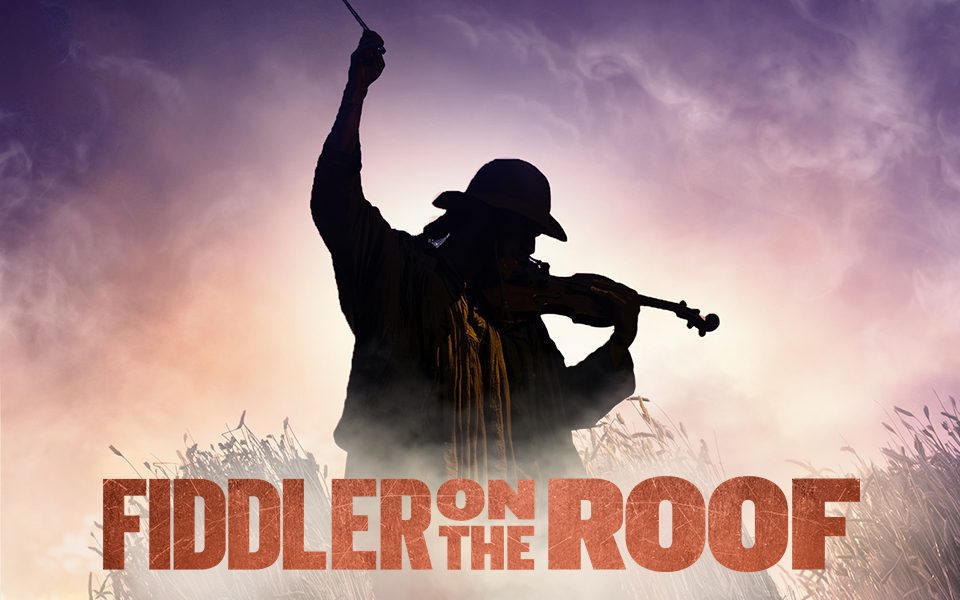
There seems to be no more appropriate time and place for this classic musical to be performed than now, in Leeds. The time, because the themes concern antisemitism, persecution and forced displacement, by Imperialist Russia in the area which is now Ukraine. The place, because Leeds used to have a large Jewish community, which helped make the city the amazing place it is today. Burton Tailors, Stylo Shoes and Marks and Spencer being just three of the mega companies founded by Jewish businessmen, providing employment to thousands. There were also numerous artists, entertainers, philanthropists, politicians, academics etc.
Leaving the story aside, I found the work very evocative of my childhood and youth, when, although brought up a Christian, a lot of my friends were Jewish, and just about all of my dad’s were, he being raised on the edge of the area then known as Leylands, which comprised the triangle between Eastgate, Regent Street and North Street, and was the ghetto. The Jewish school is still standing, although the last time I saw it it was the Crown Chinese Restaurant. To put things in perspective, in 1949, the year I was born, there were almost 30,000 Jews in Leeds, even in the 1970s the proportion relative to population, was still the largest of any city in the country. Today the number is fewer than 7,000. It was great to hear some good old Yiddish expressions I haven’t come across for quite some time.
From the above opening, you could be forgiven for thinking that this was an intense piece of theatre, and it was, but it was also laden with lots of laughter, well, of course it was, humour is the best stress buster there is, as well as being a great way to get back at your enemies. The kosher version being the most barbed of all.
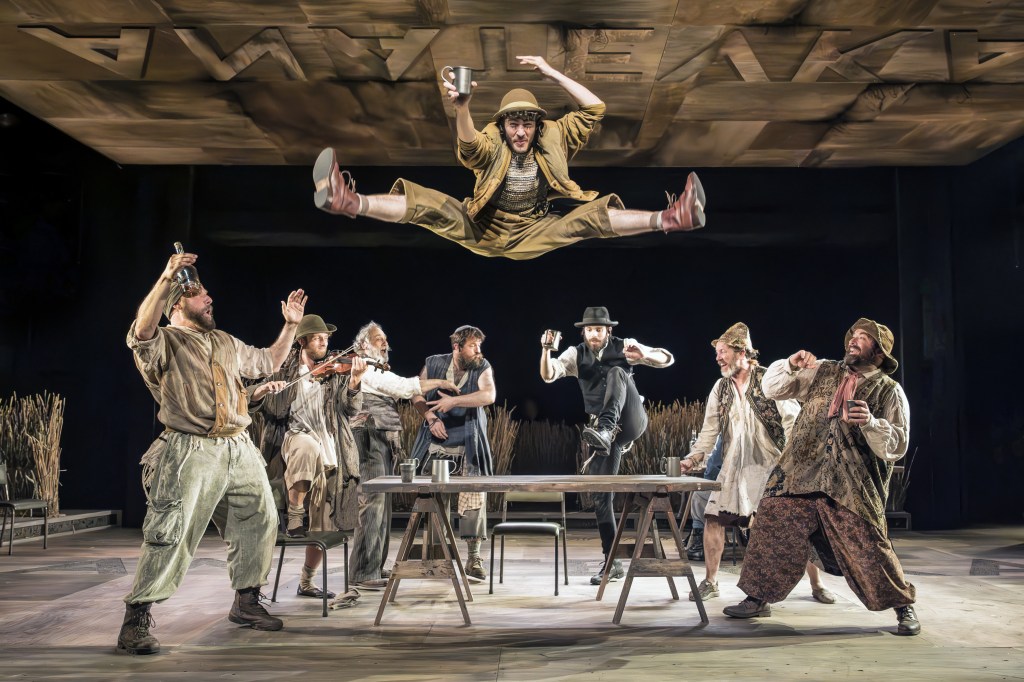
The cast, with Matthew Woodyatt as Tevye, far left, then the Fiddler, Rafael Papo (on the night played by Roman Lytwyniw – both the Fiddler and the fiddle!); Lazar Wolf, Michael S Seigel; Innkeeper, Siôn Lloyd;
Fiddler on the Roof is a musical by Jerry Bock and Sheldon Harnick, based on a book by Joseph Stein, in turn drawing on short stories by Sholem Aleichem. It centres around Tevye, a poor Jewish milkman, so badly off that he has to pull the milk cart himself as his horse is lame, and is set at the turn of the 19th/20th Centuries when new moral practices were replacing the old customs, especially in relation to marriage. He lives in a Russian shetl (Yiddish for small town) called Anatevka, where life is ‘as precarious as a fiddler on the roof’.
Tevye has five daughters, and the traditional way to get them hitched was by utilising the services of a matchmaker in order to find a husband who is as rich and good looking as is appropriate for the prospective brides. In the second act, Tevye informs us that the first time he ever saw Golde, his wife, was on their wedding day.
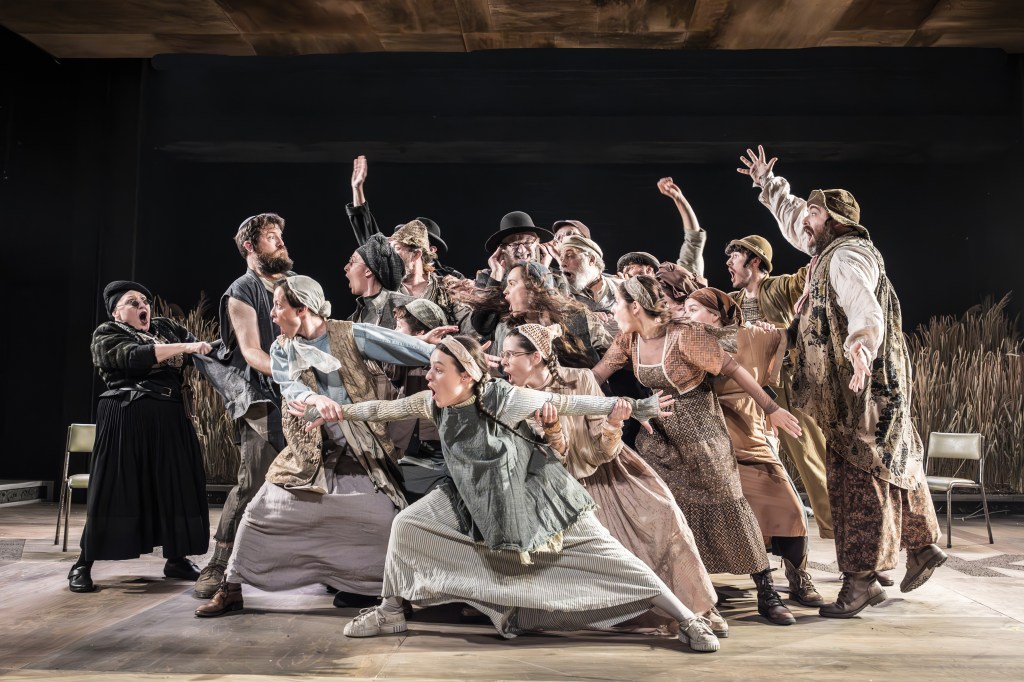
The cast, with Beverley Klein as Yente, the Matchmaker, left.
The matchmaker, Yente, hilariously played by Beverley Klein, has found a candidate for the eldest daughter, Tzeitel, in the local butcher, Lazar Wolf, who has a thriving business but is a widower in his 60s. Tzeitel, however, has fallen in love with her childhood friend, Motel, the callow, nerdy tailor, who has neither money nor prospects. Although Tevye and Wolf have shaken hands on the agreement that the wedding will take place, the youngsters win him round and he changes his mind in order for them to wed. This leads to an elaborate deception to persuade Golde, who is all for the original arrangement, to go along with the idea.

Georgia Bruce, as Hodel (played this evening by Ashleigh Shuman) and Daniel Krikler as Perchik (played tonight by Greg Bernstein). Breaking the rules by dancing whilst not yet married.
Meanwhile, a young stranger, Perchik, arrives in town and overhears a conversation between Tevye and a bookseller, who tells him news of pograms and expulsions taking place nearby. Perchik castigates the men for doing nothing but talk. After taking Perchik home for Sabbath dinner, Tevye engages him to be the girls’ teacher. The impending trouble is confirmed when the local constable tells Tevye that there is going to be ‘a little demonstration’ in the near future, and, whilst having sympathy for the Jewish community, explains that there is nothing he can do to stop it.
During the wedding ceremony, Wolf causes a scene, saying that it is he who should be the groom, but his ranting is cut short when the constable arrives with a group of local gentile Russians for the ‘little demonstration’, who start a fight and wreck the venue.
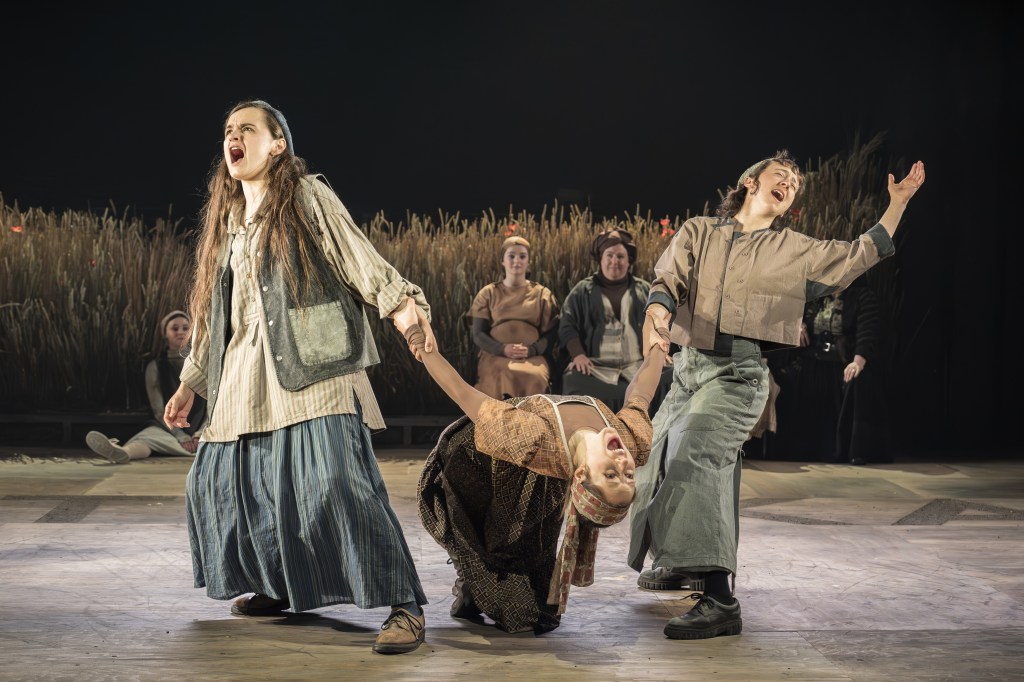
Chava, Hannah Bristow; Tzeitel, Natasha Jules Bernard and Hodel, Georgia Bruce (played tonight by Ashleigh Shuman)
As the lessons progress, Perchik and Hodel, Tevye’s second daughter, fall in love and arrange their own marriage, which outrages Tevye, especially as Perchik has said he is leaving the village to return to Kyiv to work for the revolution, but will send for her when he has settled. They further upset him by saying that they are not asking for his permission, only his blessing. Again, Tevye relents, grants their wish, and has to explain his decision to Golde.
Word arrives in town that Perchik has been arrested and sent to prison in Siberia, so Hodel, decides that she must leave to be with him. Even more devastating news reaches Tevye in that his third daughter, Chava, has been seen with Fyedka, one of the Russians at the demonstration, albeit a moderate who tried to break up the attack.
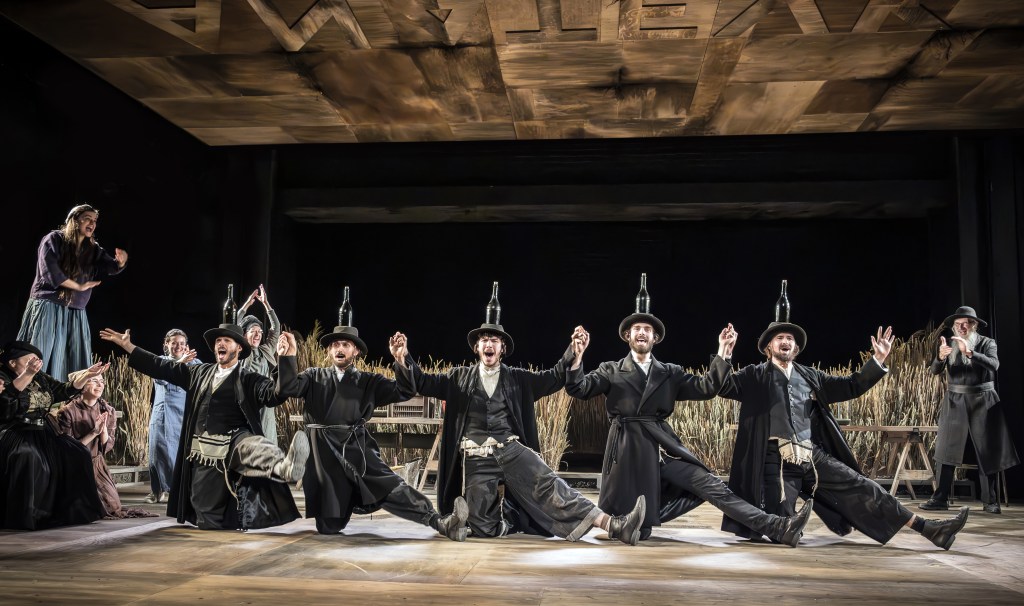
The cast performing the incredible Bottle Dance. To see how it is done please go to https://www.youtube.com/watch?v=faFEqbHtV3E
Some time later, we rejoin the story when Motel has bought a sewing machine to expand his tailoring business to provide for Tzeitel and their new baby. Chava and Fyedka are now the focus of attention when they say that they want to marry. Taking a husband from outside the religion is one step too far for Tevye and, not only does he refuse the request, but forbids Chava from ever talking to Fyedka again. This causes the lovers to elope and, when she returns to talk with her father, he refuses to see her and instructs the family to treat her as though she had died.
The constable also returns with the news that the Russians are expelling Jews from their villages and the inhabitants of Anatevka have three days in which to pack up and leave. Chava and Fyedka move to Krakow. Motel and Tzeitel also head to Poland whilst Tevye and Golde set sail for America. Followed by the Fiddler.
As you have probably gathered from the synopsis, the show had a cast of thousands, each of whom played their part supremely well. I have a feeling that it was the singing and dancing which clinched some of the roles as both of those elements were brilliant. Dan Wolff as Motel was hilariously awkward in his terpsichorean endeavours, a look which requires exceptional skill. The singing was flawless by all concerned, possibly because some of it was basically acting to music, as in If I Were A Rich Man. The more conventional numbers, such as Sunrise, Sunset and Matchmaker brought the house down.
The musicianship of the orchestra was also top notch, literally, with some of the players on the stage at the back of the upper level, partially hidden by the cereal crop!
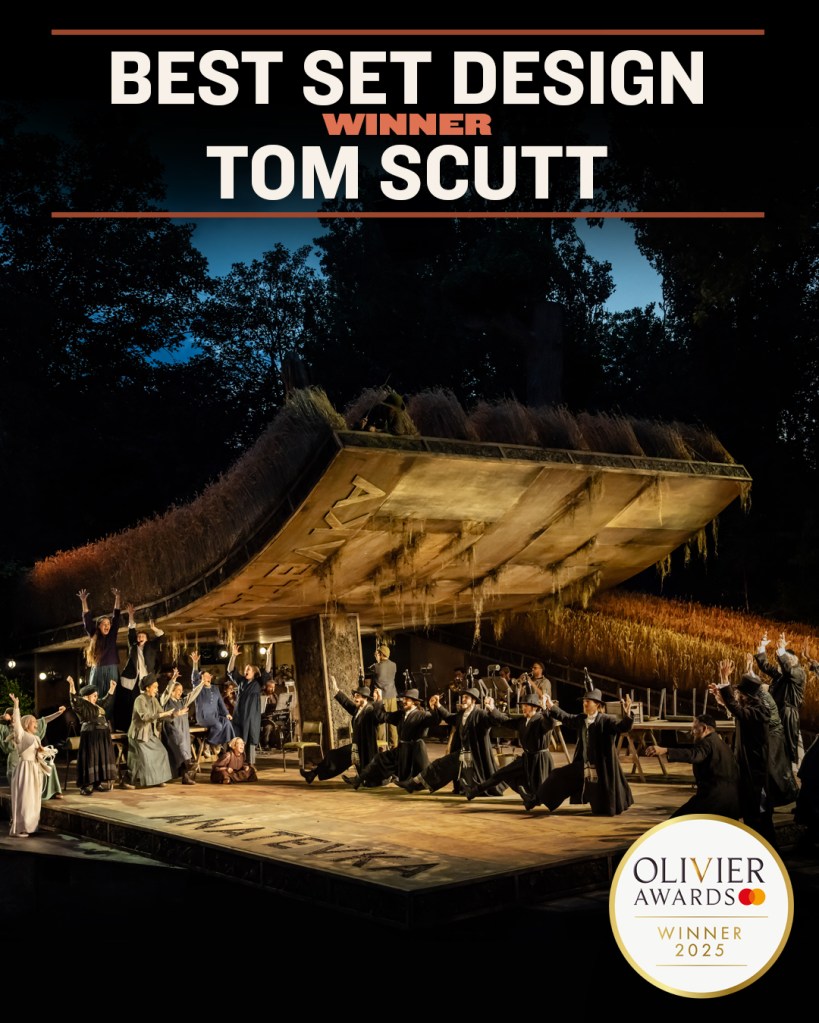
The set was breathtaking and won an Olivier Award for Tom Scutt. Sadly, none of the photographs provided feature it in a conventional theatre setting, the version on the picture above, was taken at Regent’s Park Open Air Theatre. At the Grand, the top level began on the surface of the stage and was gradually elevated, with the Fiddler atop, to provide the roof. It was also flat, rather than curved as on the photo.
Equally sadly, there are no photographs of the two main characters, Matthew Woodyatt as Tevye – except in the group shot – and Jodie Jacobs as Golde. Not my fault, I only post what I am given. I alluded to the singing and dancing being the reason for casting some of the parts and I say this because the big let down for me was Matthew Woodyatt. His acting was terrific, his frustration at the changing attitudes, combined with a comedic prowess was very impressive. What was less so, however, was that, on checking the programme, I was surprised to see that there was neither voice nor dialect coach so, despite the play being location-specific in Russia and most of the characters employing the appropriate voice, he delivered his lines in a broad Welsh accent, which shattered the mood more than somewhat. Jodie Jacob’s Cockney-influenced brogue seemed not to be as jarring, probably because the large Jewish community in London make it the norm for those of that faith. I realise that my thought process is somewhat ‘individual’ but I was very much hoping that Tevye would make his entrance in the second half by saying ‘Shalom, what’s occurrin’.’
That, quite fundamental, gripe aside, this is definitely a show to see and to do so, please go to https://leedsheritagetheatres.com/whats-on/fiddler-on-the-roof-2025/ Be quick as it only runs until Saturday, 2nd August.
For details of other productions at Heritage Theatres please see https://leedsheritagetheatres.com/whats-on/
Photographs by Marc Brenner
 Tyke It To The Limit